
Your summer reading recommendation (from a very different workplace)
A book about Amazon's culture has something important to say to school leaders. (If you'll let it.)

One of the questions I get most often from heads of school, department chairs, and staff or faculty who pull me aside after a workshop is some version of: how bad is it, really? They’re usually asking me about their organizational culture. And what I’ve learned is that behind that question is almost always a second, quieter one: am I allowed to say that I think it’s a problem?
It’s a hard question to answer, not because the data isn’t there, but because in schools and nonprofits, the mission has a way of absorbing a lot of pain. We work in calling fields where people chose their jobs on purpose because the work means something, and that sense of purpose is genuinely one of the great gifts of this sector. It’s also, sometimes, a very effective anesthetic.
This summer I want to recommend a book that has nothing to do with schools, and everything to do with the how-bad-is-it question: Kristi Coulter’s Exit Interview: The Life and Death of My Ambitious Career.
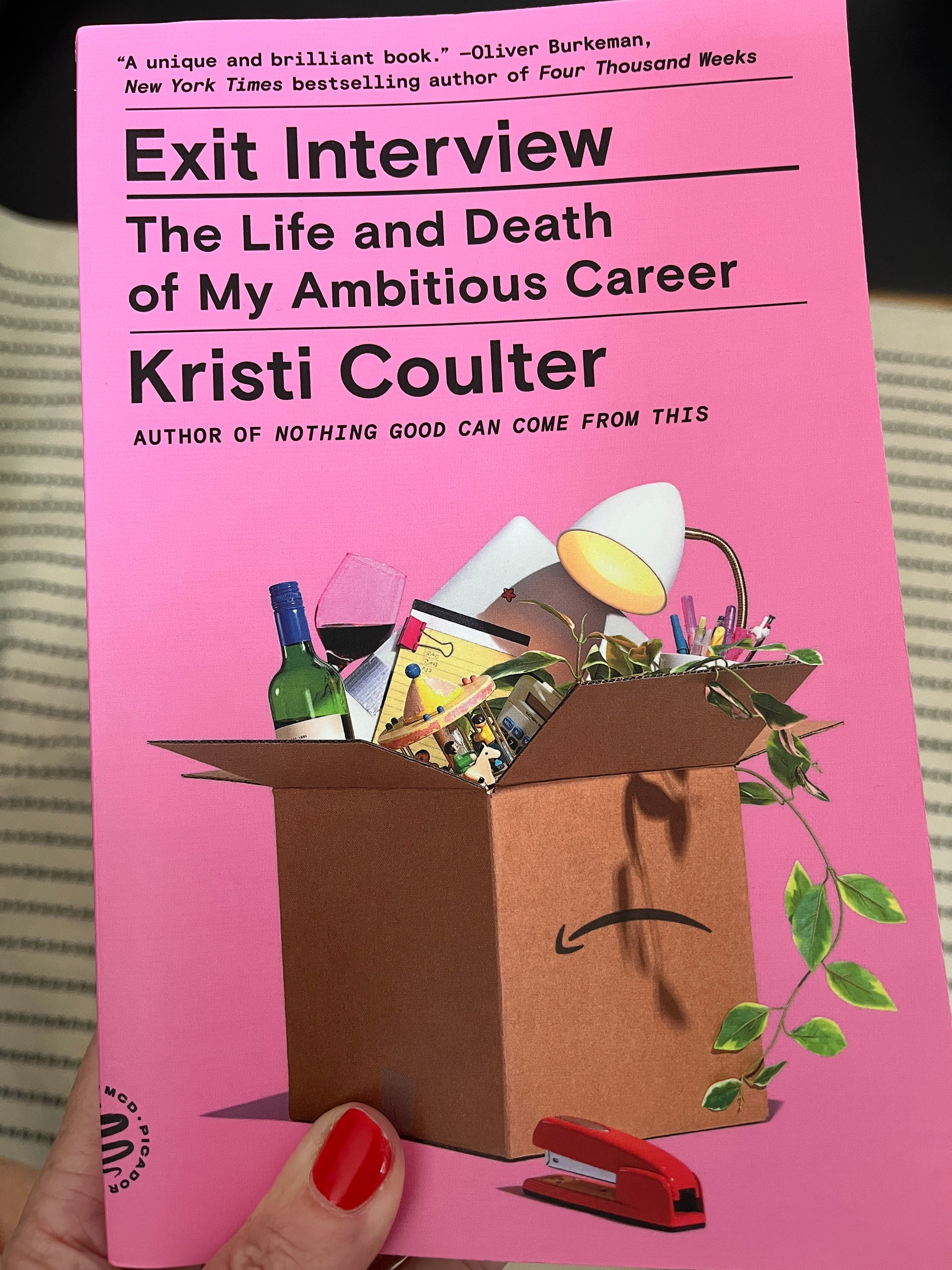
Coulter spent twelve years inside Amazon’s Seattle offices, working across departments through five major reorganizations. The book is her account of what that actually looked like. Not the often mythologized and venerated “Day 1” culture, but the daily texture of a place wildly out of balance. There’s the go-bag kept under her desk. The meeting where Coulter was told by a senior manager that her proposal was, bluntly, “stupid; you’re stupid.” The bottle of wine and two Benadryl it took to fall asleep most nights.
Honestly, when I first picked it up, I wasn’t sure it would land for an audience of independent school leaders. I’d heard about it from my organizational psychology practitioner friends not thinking “oh, this will have great relevance to school leaders.” The world Coulter describes that was rife with stock options, aggressive reorganizations, and a true churn-and-burn ethos, is about as far from a school campus as you can get. That distance, I’d argue, is exactly the point.
Before I encountered the research on counterproductive workplace behaviors and organizational deviance, I understood toxicity mostly in the abstract. I knew the academic definitions and I could describe harmful workplace behaviors with reasonable fluency, however I couldn’t get a feel for what it looked like in an actual work setting. Coulter’s book closed that gap for me in a way that the research literature could not, because it shows you what twelve years of workplace harm looks like from the inside. My takeaway was that it wasn’t one dramatic moment (though being called “stupid” certainly felt like a big moment to me), rather it was more of a slow accumulation of micro-toxic events.
And here’s where I think it speaks directly to school leaders: the accumulation doesn’t require a villain. Amazon’s culture wasn’t built by one bad actor. It was built by systems, incentives, and perhaps most crucially, by smart, talented people who kept deciding that the rewards justified the cost. Coulter herself stayed for twelve years and encountered all manners and forms: Gaslighting managers. Rumors of big changes with no timeline or impact. A boss who went silent for months about her future at the company. Desks made of old doors, full of splinters. And year after year, watching people (typically men) advance past her despite comparable, even superior, performance. Her husband’s observation near the end of the book is the line I keep returning to:
“You can leave anytime. You’re choosing to stay.”
That line hits differently in a school context than it might in tech. In education and nonprofit work, choosing to stay is often framed as virtuous: dedication, commitment, and love of the mission. And it can be all of those things, but it can also be a way of not asking harder questions about what, exactly, we are staying for, and what we are quietly tolerating in order to do it.
I’m not suggesting that our workplaces are Amazon. What I am suggesting is that mission-driven cultures have their own version of this dynamic–one that can be harder to name because the mission is real and the people tend to be genuinely good. In my experience, conflict-averse leaders often find it easier to absorb dysfunction into the narrative of purpose than to confront it directly. The question Coulter forces is whether that’s sustainable, both for the institution and for the people inside it.
Read this book as a case study in the outer limits of workplace harm. Let it recalibrate your sense of what ‘bad’ actually looks like. Then ask your leadership team what struck them. If you’re honest with yourself, ask where your own red line is and whether the people working for you know that you have one.
I recommend the audiobook first. Coulter reads it herself, and the tone she brings is something the page alone doesn’t quite capture.
If you read it, let me know. What landed? What made you uncomfortable? What made you think of your own school? And if you finish the book and want a set of facilitation questions to use with your team or leadership group designed to help you look honestly at your own culture–reach out. I’m happy to send them your way.